
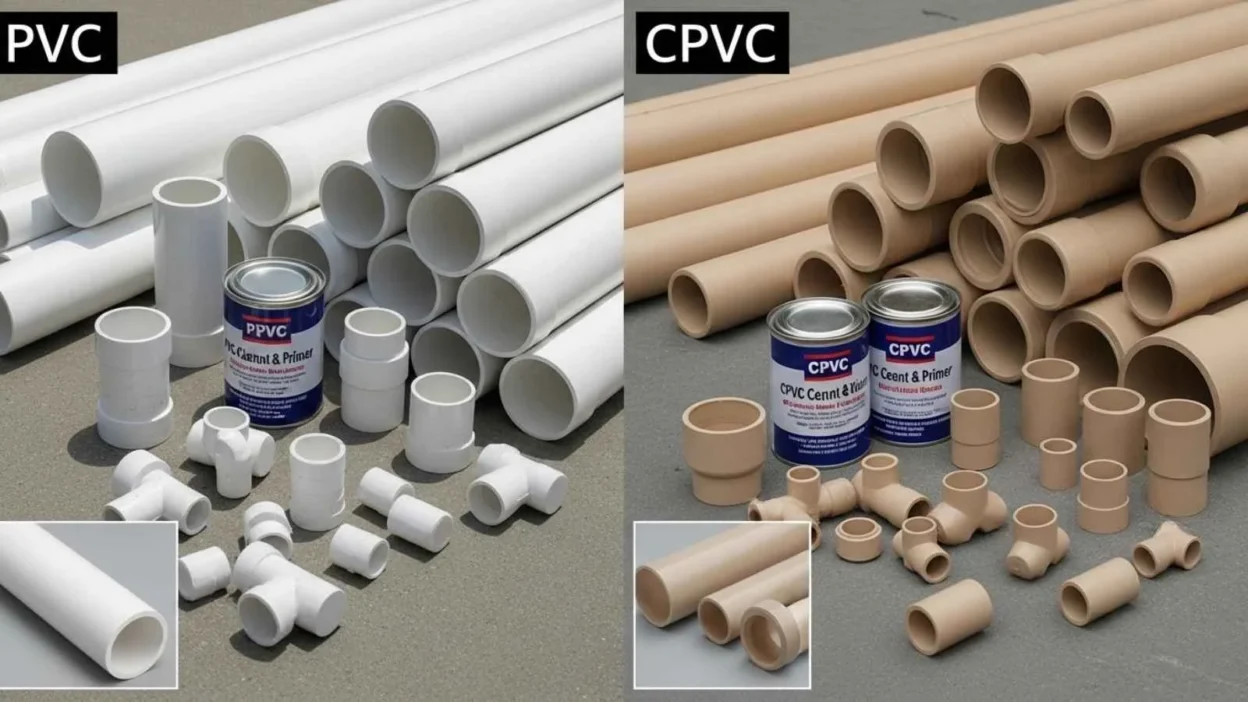
Many people search for “PVC or CPVC” because the two names look very close. They are both plastic pipe materials. They are both used in homes and buildings. That is why many people get confused.
The simple answer is this: PVC and CPVC are not the same. PVC is often used for cold water, drains, and outdoor pipes. CPVC can handle higher heat, so it is often used for hot and cold water lines inside homes. This is the main difference.
People often ask this question when they are building a house, fixing pipes, or buying plumbing material. In this article, you will get a quick answer, easy examples, common mistakes, and simple advice. By the end, you will understand the difference between PVC and CPVC and know which one may be better for your needs.
PVC or CPVC – Quick Answer
Quick answer:
Use PVC for cold water, drainage, and many outdoor uses.
Use CPVC for hot and cold water supply lines.
Simple examples
- A drain pipe is often PVC.
- A hot water pipe is often CPVC.
- Outdoor irrigation may use PVC.
- A home water line may use CPVC.
So, the easy rule is this:
- PVC = good for cold water and drains
- CPVC = good for hot and cold water
The Origin of PVC or CPVC
The name PVC stands for Polyvinyl Chloride. It is a common plastic material used in many products, including pipes.
The name CPVC stands for Chlorinated Polyvinyl Chloride. It is made from PVC, but it goes through another process. That process helps it handle more heat.
So, the two names come from the same base material, but CPVC is changed to do more.
Simple idea
- PVC = basic pipe plastic
- CPVC = stronger for heat
That is why they are similar, but not the same.
British English vs American English Spelling
Here is the important point:
There is no UK or US spelling difference between PVC and CPVC.
These are material names, so they stay the same in all regions.
Comparison table
| Feature | PVC | CPVC |
| Full form | Polyvinyl Chloride | Chlorinated Polyvinyl Chloride |
| US spelling | PVC | CPVC |
| UK spelling | PVC | CPVC |
| Main use | Cold water, drains | Hot and cold water |
| Heat handling | Lower | Higher |
Simple table
| Word | Meaning | Main use |
| PVC | Plastic pipe material | Drainage and cold water |
| CPVC | Heat-ready plastic pipe material | Hot and cold plumbing |
So, this topic is not about spelling. It is about pipe material and use.
Which One Should You Use?
Use PVC when you need a pipe for cold water, waste lines, or outdoor systems.
Use PVC when:
- You need drain pipes
- You need sewer lines
- You need a cold water flow
- You need outdoor irrigation
- You want a lower-cost option
Examples:
- The garden line may use PVC.
- A sink drain may use PVC.
- Many waste pipes are made from PVC.
Use CPVC when you need a pipe that can handle heat.
Use CPVC when:
- You need hot water lines
- You need indoor supply pipes
- You need both hot and cold water for use
- You want more heat resistance
Examples:
- A bathroom hot water line may use CPVC.
- A kitchen supply line may use CPVC.
- Many home plumbing systems use CPVC for warm water.
Audience-based advice
For homeowners:
Use PVC for drains and outdoor pipes. Use CPVC for hot water lines.
For builders:
Choose the one that matches the water type and heat level.
For general users:
If heat is involved, CPVC is often the better choice.
Common Mistakes with PVC or CPVC
People often mix these two materials up. Here are some common mistakes.
1. Using PVC for hot water
This is one of the biggest mistakes.
Wrong choice: Using PVC for a hot water line
Better choice: Use CPVC
2. Thinking both are exactly the same
They look close, but CPVC is made to handle more heat.
3. Using the wrong glue or fittings
Some people think all pipe cement is the same. It is important to use the right type for the right pipe.
4. Choosing by price only
PVC is often cheaper, but the cheaper option is not always the right one.
5. Ignoring the job type
Drainage and hot water lines do not need the same material.
Quick correction table
| Mistake | Better choice |
| PVC for hot water | CPVC |
| Thinking both are the same | Learn the heat difference |
| Using wrong cement | Use the correct pipe cement |
| Choosing only by low price | Choose by use |
PVC or CPVC in Everyday Examples
Here are easy examples of how people use these words.
In emails
- “Should we install PVC or CPVC in this house?”
- “Please use CPVC for the hot water line.”
- “The drain pipe can be PVC.”
In news-style writing
- “The builder changed from PVC to CPVC for the hot water system.”
- “PVC pipes were used in the drainage work.”
On social media
- “Which is better for plumbing, PVC or CPVC?”
- “I used PVC for my garden pipe.”
- “My plumber said CPVC is better for hot water.”
In formal writing
- “The project uses PVC for drain lines and CPVC for hot water supply.”
- “The plumbing plan separates PVC and CPVC by application.”
These examples show how the two terms are used in real life.
PVC or CPVC – Google Trends & Usage Data
People search “PVC or CPVC” because they want to know which pipe material is right for their project. In most cases, the search intent is simple:
- Which one is better for hot water
- Which one is better for drains
- Which one costs less
- Which one lasts longer
- Which one should be used in plumbing
Simple popularity table
| Term | Search intent | Common use |
| PVC | Material research | Drains, cold water, outdoor use |
| CPVC | Material research | Hot water, plumbing |
| PVC or CPVC | Comparison search | Choosing pipe material |
Popularity by country and context
This topic is common in places where people build homes, fix plumbing, or buy pipe material. Homeowners, plumbers, and builders often search for it because the two names are very similar, but the uses are not the same.
So, the main idea is simple:
People search for this keyword when they want to avoid using the wrong pipe.
Comparison Table: PVC vs CPVC
| Point | PVC | CPVC |
| Main meaning | Standard plastic pipe | Heat-resistant plastic pipe |
| Best for | Cold water and drains | Hot and cold water |
| Heat resistance | Lower | Higher |
| Common use | Drainage, sewer, irrigation | Home plumbing |
| Cost | Often lower | Often higher |
| Easy idea | Good for cold jobs | Good for hot jobs |
FAQs:
1. What is the main difference between PVC and CPVC?
The main difference is heat. CPVC can handle more heat than PVC.
2. Can I use PVC for hot water?
It is usually not the best choice. CPVC is better for hot water.
3. Is CPVC stronger than PVC?
For hot water and heat use, CPVC is usually the better option.
4. Is PVC cheaper than CPVC?
In many cases, yes. PVC is often less costly.
5. Which one is better for drain pipes?
PVC is often used for drain pipes.
6. Which one is better for a home water supply?
CPVC is often used for hot and cold water supply lines.
7. Can PVC and CPVC be used the same way?
No. They are similar, but they are not made for all the same jobs.
Conclusion
The choice between PVC or CPVC is not about spelling. It is about choosing the right pipe material. PVC is often the better choice for cold water, drains, sewer lines, and outdoor use. CPVC is often the better choice for hot water and indoor water supply lines.
This is easy to remember. If the job involves heat, choose CPVC. If the job is a drain or cold-water line, PVC may be the better fit. That simple rule can help you avoid mistakes and pick the right material for your project.
So, when you ask “PVC or CPVC,” think about one thing first: Will the pipe carry hot water? If yes, CPVC is often the safer choice. If not, PVC may work well.

I am an English language writer dedicated to helping readers understand confusing words, spelling differences, and grammar rules. Through clear explanations and practical examples, I makes complex language topics easy to understand. My articles focus on improving everyday English for learners around the world.