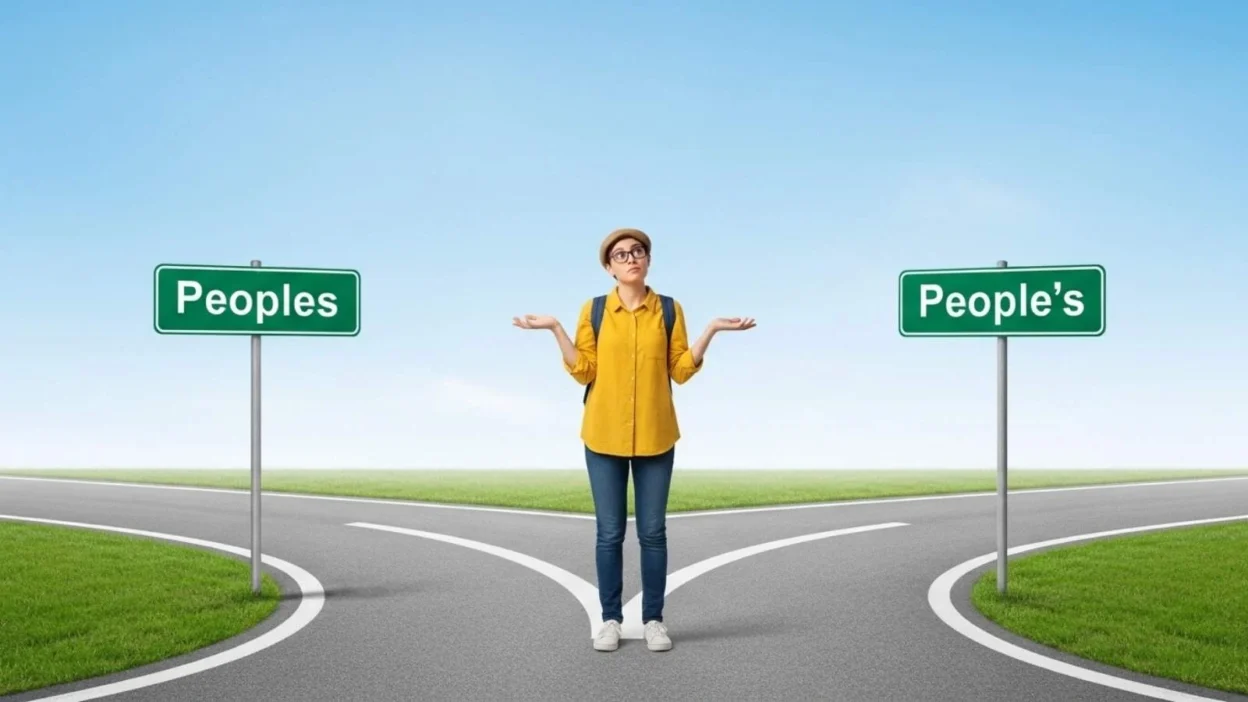
Many writers stop and think when typing peoples or people’s. The words look almost the same. But the meaning is very different.
This confusion happens because both forms come from the word people. One shows plural meaning. The other shows possession. A small apostrophe changes everything.
People search for this keyword because they want to write correctly. Students, bloggers, and professionals often ask: Is it peoples rights or people’s rights? Is peoples even correct in English?
This guide gives a quick answer first. Then it explains the grammar, history, examples, and common mistakes. By the end, you will know exactly which form to use.
Peoples or People’s – Quick Answer
Short answer:
- People’s = something belongs to people. (Possession)
- Peoples = more than one group of people. (Plural of people)
Examples:
- ✅ People’s rights = rights that belong to people
- ✅ Indigenous peoples = many ethnic groups
If you are talking about ownership, use people’s. If you are talking about different nations or groups, use peoples.
The Origin of Peoples or People’s
The word people comes from the Latin word populus, meaning a nation or community.
Over time:
- People became the common plural of person.
- Peoples developed to describe multiple nations or ethnic groups.
- People’s formed as the possessive version of people.
So:
- People = plural of person
- Peoples = plural of groups or nations
- People’s = possessive form
The apostrophe in people’s shows ownership.
British English vs American English Spelling
There is no spelling difference between British and American English for peoples or people’s.
Both follow the same grammar rules.
| Form | Meaning | Example |
|---|---|---|
| People | More than one person | The people are happy. |
| Peoples | Multiple nations/groups | Indigenous peoples live here. |
| People’s | Belonging to people | People’s voices matter. |
Unlike words such as “color/colour,” this keyword is about grammar, not spelling differences.
Which Spelling Should You Use?
It depends on what you mean.
Use People’s if:
- You show ownership
- You mean “belonging to people”
- You are writing about rights, opinions, property
Example: “People’s opinions are important.”
Use Peoples if:
- You talk about different ethnic groups
- You refer to multiple nations
Example: “The cultures of African peoples are diverse.”
For Global Writing:
Most writers use people’s more often in daily writing. Peoples is common in academic, historical, or political texts.
Common Mistakes with Peoples or People’s
Here are frequent errors:
- ❌ Peoples rights are important. ✔ People’s rights are important.
- ❌ The people’s of Asia are diverse. ✔ The peoples of Asia are diverse.
- ❌ Adding apostrophe in plural form ✔ Apostrophe only shows possession.
- ❌ Confusing with “peoples’” ✔ Peoples’ is rare and means something belongs to multiple groups.
Peoples or People’s in Everyday Examples
Email: “Please respect people’s privacy.”
Social Media: “We must protect people’s data online.”
News Article: “The rights of Indigenous peoples were discussed.”
Formal Writing: “The agreement protects the sovereignty of tribal peoples.”
The context decides the correct form.
Peoples or People’s – Google Trends & Usage Data
Searches for “peoples or people’s” are common among:
- Students
- ESL learners
- Bloggers
Most searches happen during:
- Essay writing
- Grammar checking
- Academic research
“People’s” appears far more often in everyday writing. “Peoples” is more common in political, cultural, and academic contexts.
Comparison Table: Peoples vs People’s
| Word | Type | Meaning | Common Usage |
|---|---|---|---|
| Peoples | Plural noun | Multiple ethnic/national groups | Academic writing |
| People’s | Possessive noun | Something belongs to people | Daily writing |
| Peoples’ | Possessive plural | Belonging to multiple groups | Rare usage |
FAQs:
Yes. It refers to multiple groups or nations.
2. What does “people’s” mean?
It shows possession. Something belongs to people.
3. Which is more common?
People’s is more common in everyday writing.
4. Can I say “peoples rights”?
No. It should be “people’s rights.”
5. What is “peoples’”?
It means something belongs to multiple groups. It is rarely used.
6. Is this a British vs American difference?
No. Both use the same rules.
7. Why is this confusing?
Because the apostrophe changes meaning but not pronunciation.
Conclusion
The difference between peoples or people’s is simple once you understand grammar.
Use people’s when something belongs to people. The apostrophe shows possession. This form is common in daily writing.
Use peoples when talking about multiple nations or ethnic groups. This form appears more in academic and political texts.
There is no spelling difference between British and American English. The key is meaning, not location.
Remember: Apostrophe = ownership. No apostrophe = multiple groups.
When you know the purpose of your sentence, choosing the right form becomes easy.