
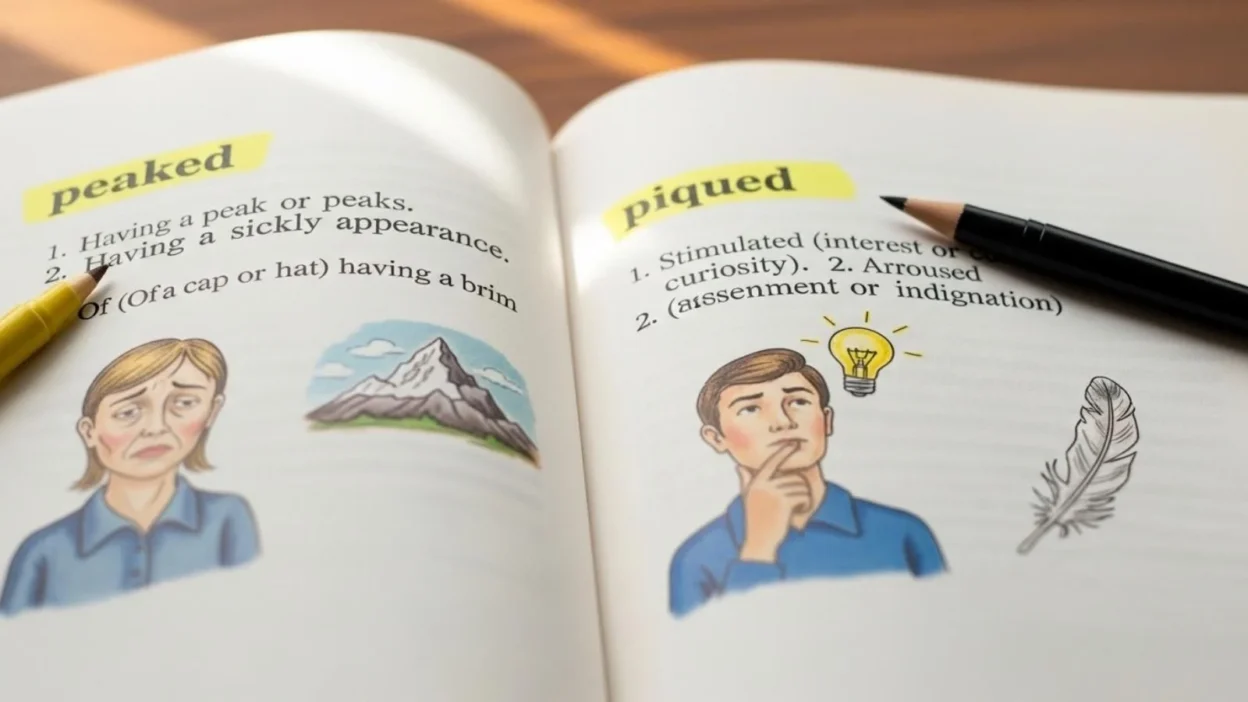
Many people search “peaked or piqued” when they see the phrase “peaked my interest” or “piqued my interest.” The two words sound the same, so they are easy to confuse. In English, words that sound the same but have different meanings are called homophones.
The confusion often happens when people want to say that something caught their attention. For example, someone may read an article or hear an idea that makes them curious. Many people write “peaked my interest,” but the correct phrase is usually “piqued my interest.”
The word piqued means to stimulate curiosity or interest. The word peaked, however, has a different meaning. It refers to something reaching the highest point or top level.
Because these words sound the same, writers often mix them up. This guide explains peaked or piqued in very simple words. You will learn the difference, when to use each word, and how to avoid common mistakes.
Peaked or Piqued – Quick Answer
The correct phrase is “piqued my interest.”
| Word | Meaning | Example |
|---|---|---|
| Piqued | To make someone curious | The story piqued my interest. |
| Peaked | Reached the highest point | Sales peaked last year. |
Simple Example
- Piqued: The book piqued my interest.
- Peaked: The mountain has a sharp peak.
So when you talk about curiosity, use piqued.
The Origin of Peaked or Piqued
Understanding where the words come from can help explain their meanings.
Piqued
The word piqued comes from the French word “piquer.” It means to prick or stimulate.
Over time, English began using piqued to describe curiosity or interest.
Example:
- The new idea piqued my curiosity.
Peaked
The word peaked comes from the noun “peak.” A peak is the highest point of something, like the top of a mountain.
Example:
- The runner’s speed peaked during the race.
These words developed from different origins, which is why they have different meanings.
British English vs American English Spelling
The spellings peaked and piqued are the same in American English and British English.
| Word | US Spelling | UK Spelling |
|---|---|---|
| Peaked | Peaked | Peaked |
| Piqued | Piqued | Piqued |
There are no spelling differences between the two regions.
Which Spelling Should You Use?
Choose the word based on the meaning you want.
| Word | When to Use |
|---|---|
| Piqued | When something makes you curious |
| Peaked | When something reaches its highest level |
Simple Advice
- Curiosity → piqued
- Highest point → peaked
Example:
- The mystery movie piqued my interest.
- Her performance peaked in the final round.
Common Mistakes with Peaked or Piqued
Here are mistakes people often make.
1. Writing “Peaked My Interest”
The correct phrase is “piqued my interest.”
2. Thinking the Words Are Interchangeable
They have different meanings.
3. Confusing the Pronunciation
Both words sound the same, which causes confusion.
4. Using Peaked for Curiosity
Use piqued when talking about interest or curiosity.
Peaked or Piqued in Everyday Examples
Here are simple examples of how these words appear in daily writing.
Email Example
“Your idea really piqued my interest.”
News Example
“Public interest peaked after the announcement.”
Social Media Example
“The trailer piqued my interest.”
Formal Writing Example
“The discovery piqued the scientist’s curiosity.”
Peaked or Piqued – Google Trends & Usage Data
Search data shows that many people search “peaked or piqued” to check the correct phrase.
The phrase “piqued my interest” appears much more often in books and articles.
Countries With High Searches
| Country | Search Level |
|---|---|
| United States | High |
| United Kingdom | High |
| Canada | Medium |
| Australia | Medium |
Common Search Questions
People often ask:
- Is it peaked or piqued my interest?
- What does piqued mean?
- Why do these words sound the same?
- Which one is correct?
These questions show that people want clear answers about common writing mistakes.
Comparison Table: Peaked vs Piqued
| Feature | Peaked | Piqued |
|---|---|---|
| Meaning | Reached highest point | Stimulated curiosity |
| Word Type | Verb (past form) | Verb (past form) |
| Usage | Levels or performance | Interest or curiosity |
| Example | The price peaked. | The story piqued my interest. |
FAQs
1. Is it “peaked my interest” or “piqued my interest”?
The correct phrase is piqued my interest.
2. What does piqued mean?
It means to make someone curious or interested.
3. What does peaked mean?
Peaked means reached the highest point.
4. Why do people confuse these words?
They sound the same when spoken.
5. Are the spellings different in US and UK English?
No. Both regions use the same spellings.
6. Can peaked ever be correct?
Yes, when talking about something reaching its highest level.
7. How can I remember the difference?
Think of piqued as curiosity and peaked as the top point.
Conclusion
The word piqued means to create interest or curiosity. It is most often used in the phrase “piqued my interest.”
The word “peaked,” however, means that something has reached its highest point. For example, a person’s performance or a company’s sales might peak at a certain time.
Because the words sound the same, many people accidentally write “peaked my interest.” In most cases, the correct phrase should be “piqued my interest.”

I am an English language writer dedicated to helping readers understand confusing words, spelling differences, and grammar rules. Through clear explanations and practical examples, I makes complex language topics easy to understand. My articles focus on improving everyday English for learners around the world.