Many people search for “GMT or UTC” because these two time terms look very similar. They both relate to world time, maps, clocks, flights, weather reports, and online meetings. Because they are often used in the same places, many people think they mean exactly the same thing.
For example, you may see a meeting time written in UTC. But a weather report or an old clock may mention GMT. This can make people stop and ask, “Should I use GMT or UTC?” It is a common question, especially for students, bloggers, and people who work online.
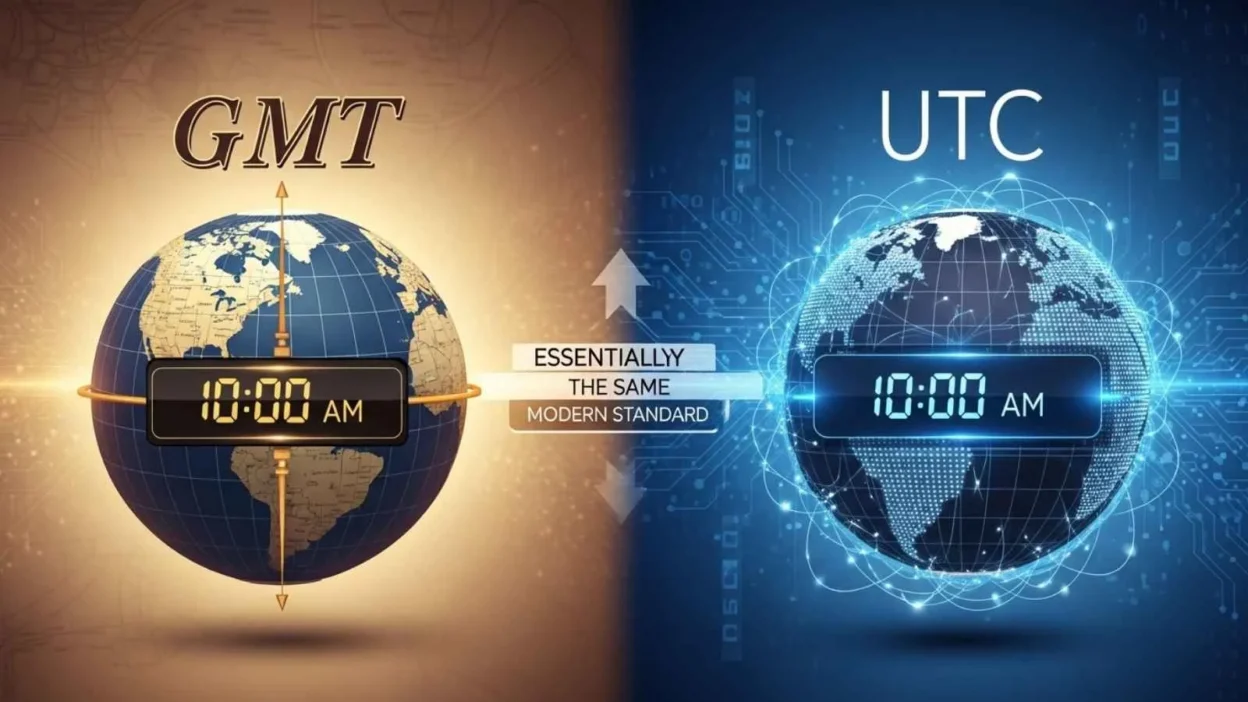
The good news is that the difference is not too hard to understand. GMT means Greenwich Mean Time. UTC means Coordinated Universal Time. They are close, but they are not exactly the same in meaning and use.
GMT or UTC – Quick Answer
The quick answer is simple:
- GMT is a time zone.
- UTC is the world standard for time.
Both are based on the same zero-hour line at Greenwich in London, so they often show the same clock time. But they are used in different ways.
Easy example
- A person may say, “London is on GMT in winter.”
- A website may say, “The event starts at 14:00 UTC.”
Quick comparison table
| Term | Full Form | Main Use |
|---|---|---|
| GMT | Greenwich Mean Time | Time zone |
| UTC | Coordinated Universal Time | World time standard |
So, if you are choosing between GMT or UTC, the answer depends on what you want to talk about.
What Does GMT Mean?
GMT stands for Greenwich Mean Time.
It is named after Greenwich, a place in London, England. Long ago, Greenwich became an important place for measuring time and maps. The time at this location was used as a starting point for other places around the world.
GMT was based on the sun and the Earth’s movement. It helped people compare the time in different countries.
Simple idea
Think of GMT as a time zone name.
Examples:
- The UK uses GMT in winter.
- Some old maps and clocks still use GMT.
What Does UTC Mean?
UTC stands for Coordinated Universal Time.
This is the main time standard used around the world today. It is used by:
- airlines
- computers
- websites
- scientists
- weather services
- global businesses
UTC is more exact than GMT. It is based on very accurate atomic clocks.
Simple idea
Think of UTC as the main world clock standard.
Examples:
- A server may save data in UTC.
- International flight systems often use UTC.
The Origin of GMT or UTC
The origin of GMT
GMT started in the 1800s. At that time, trains, ships, and communication systems needed one clear time reference. Greenwich in London became the key point for this system.
The word mean in Greenwich Mean Time refers to an average measure of solar time.
The origin of UTC
Later, the world needed a more exact time system. Scientists created UTC using atomic clocks. This made timekeeping more accurate than older solar-based systems.
The letters UTC look unusual because the world wanted one short name that worked in different languages. English speakers wanted CUT for Coordinated Universal Time, while French speakers wanted TUC. In the end, UTC was chosen as a neutral form.
So, GMT came first, and UTC came later as a more modern standard.
British English vs American English Spelling
The spellings GMT and UTC do not change in British or American English.
These are abbreviations, so the letters stay the same everywhere.
Spelling comparison table
| Term | American English | British English |
|---|---|---|
| GMT | GMT | GMT |
| UTC | UTC | UTC |
There is no US spelling and UK spelling difference here.
Which Spelling Should You Use?
Both terms are correct, but they are not used in the same way.
Use GMT when:
- you are talking about the time zone in the UK during winter
- you are writing in a simple, general way for readers
- you are discussing older time systems or common public use
Example: “London is on GMT in winter.”
Use UTC when:
- you need the exact international time
- you are writing for technology, science, aviation, or global events
- you want a modern world standard
Example: “The online class starts at 09:00 UTC.”
Easy advice from the audience
| Audience | Best Choice |
|---|---|
| US readers | UTC for exact use, GMT for simple time-zone talk |
| UK readers | GMT for local winter time, UTC for technical use |
| Global readers | UTC is usually the best choice |
So, if you want the safest choice for international writing, UTC is often better.
Common Mistakes with GMT or UTC
Many people mix these two terms. Here are some common mistakes:
| Mistake | Correct Idea |
|---|---|
| GMT and UTC are always the same thing | They often match in clock time, but they are not the same system |
| GMT is the modern world standard | UTC is the main modern standard |
| UTC is a country time zone | UTC is a global time standard |
| GMT changes all year in the UK | The UK uses GMT in winter and BST in summer |
| You can always replace one with the other | Sometimes yes, but not in every context |
Easy rule
- GMT = time zone
- UTC = world standard
That short rule helps many learners remember the difference.
GMT or UTC in Everyday Examples
Here are simple examples of how these terms appear in real life.
In an email
“Our team call will begin at 3:00 PM UTC.”
In news writing
“The event started at 12:00 UTC and was watched worldwide.”
On social media
“Live stream tonight at 8 PM GMT!”
In formal writing
“All records in this system are stored in UTC.”
In travel
“The flight schedule is listed in UTC.”
These examples show that UTC is common in modern global systems, while GMT is still common in public use.
GMT or UTC – Google Trends & Usage Data
Many people search for “GMT or UTC” because they want a quick and clear answer. This topic is common among:
- remote workers
- students
- programmers
- travelers
- bloggers
- gamers
Popular searches often include:
- gmt vs utc
- what is the difference between gmt and utc
- gmt or utc which is correct
- is gmt the same as utc
Search interest by country
| Country | Search Interest |
|---|---|
| United States | High |
| United Kingdom | High |
| Canada | Medium |
| Australia | Medium |
People usually search this topic when they need to set a meeting time or understand a time zone.
GMT vs UTC Comparison Table
| Feature | GMT | UTC |
|---|---|---|
| Full Form | Greenwich Mean Time | Coordinated Universal Time |
| Type | Time zone | Time standard |
| Based On | Solar time | Atomic clocks |
| Main Use | Public and regional time use | Global and technical time use |
| Used In | UK winter time, general use | Aviation, science, computers, world systems |
| Modern Standard | No | Yes |
This table makes the difference much easier to see.
FAQs:
1. Is GMT the same as UTC?
Not exactly. They often show the same time, but GMT is a time zone and UTC is a time standard.
2. Which one is more accurate?
UTC is more accurate because it is based on atomic clocks.
3. Which one should I use for online meetings?
UTC is usually better for global meetings.
4. Does the UK use GMT all year?
No. The UK uses GMT in winter and BST in summer.
5. Is UTC used in computers?
Yes. Many websites, apps, and servers use UTC.
6. Is GMT old-fashioned?
Not fully, but it is older than UTC and less exact for technical use.
7. Which is better for international writing?
UTC is usually the better choice for clear global communication.
Conclusion
The difference between GMT or UTC is easier to understand once you know their purpose. GMT stands for Greenwich Mean Time, and it is mainly known as a time zone. UTC stands for Coordinated Universal Time, and it is the main world standard for accurate timekeeping.
These two terms often show the same clock time, which is why people get confused. But they are not exactly the same. GMT has older roots and is linked to solar time and the Greenwich area in London. UTC is newer and more exact because it is based on atomic clocks.
In simple words, GMT is better for general time-zone talk, while UTC is better for modern global systems. If you are writing for international readers or planning online meetings, UTC is usually the best choice.
So if you are deciding between GMT or UTC, remember this easy rule: GMT is a time zone, and UTC is the world time standard. That one line can help you use both terms correctly.

I write educational content focused on English vocabulary, word comparisons, and grammar clarity. I enjoy breaking down complex language topics into simple explanations that readers of all levels can understand. My work helps learners improve their confidence in writing and communication.